

Celebrating independence in a country that welcomes the world
Europe has a slightly awkward relationship with national pride. We are not quite sure what to do with it.
In Germany, there are obvious historical reasons for that discomfort. Waving the national flag too enthusiastically can still invite suspicion, followed by endless discussions about whether Germany has finally developed a “normal” relationship with patriotism. The 2006 World Cup was treated almost as a national breakthrough: suddenly black, red and gold appeared on cars, balconies and faces, and Germans discovered that it was possible to wave a flag without invading anybody. Nearly every football tournament since has reopened some version of the same debate. The curious thing about constantly insisting that your patriotism is now perfectly normal is that it rather suggests you are still not entirely comfortable with it.
Britain has found its own ways of making the flag complicated. St George’s Crosses and Union Flags have recently appeared on lamp-posts and roundabouts as part of the “Raise the Colours” campaign, triggering arguments about immigration, national identity and who gets to define patriotism. Some councils have removed them, citing the dangers of people climbing ladders beside busy roads and attaching things to public infrastructure. So Britain has somehow reached the point where putting up the national flag can simultaneously become a culture war and a highway-safety problem.
The Dutch take a more cheerful approach: they save a large part of their nationalism for football and then go completely overboard. During a major tournament, Oranjekoorts, orange fever, takes over. People dress in orange, shops turn orange, cars turn orange and whole streets disappear beneath bunting. This summer, residents of the Marktweg in The Hague spent weeks covering façades, trees and streetlights in orange for the World Cup. It is patriotism with an on-off switch: socially sanctioned, spectacularly excessive and conveniently attached to eleven men chasing a ball.
Then you come to Vietnam.
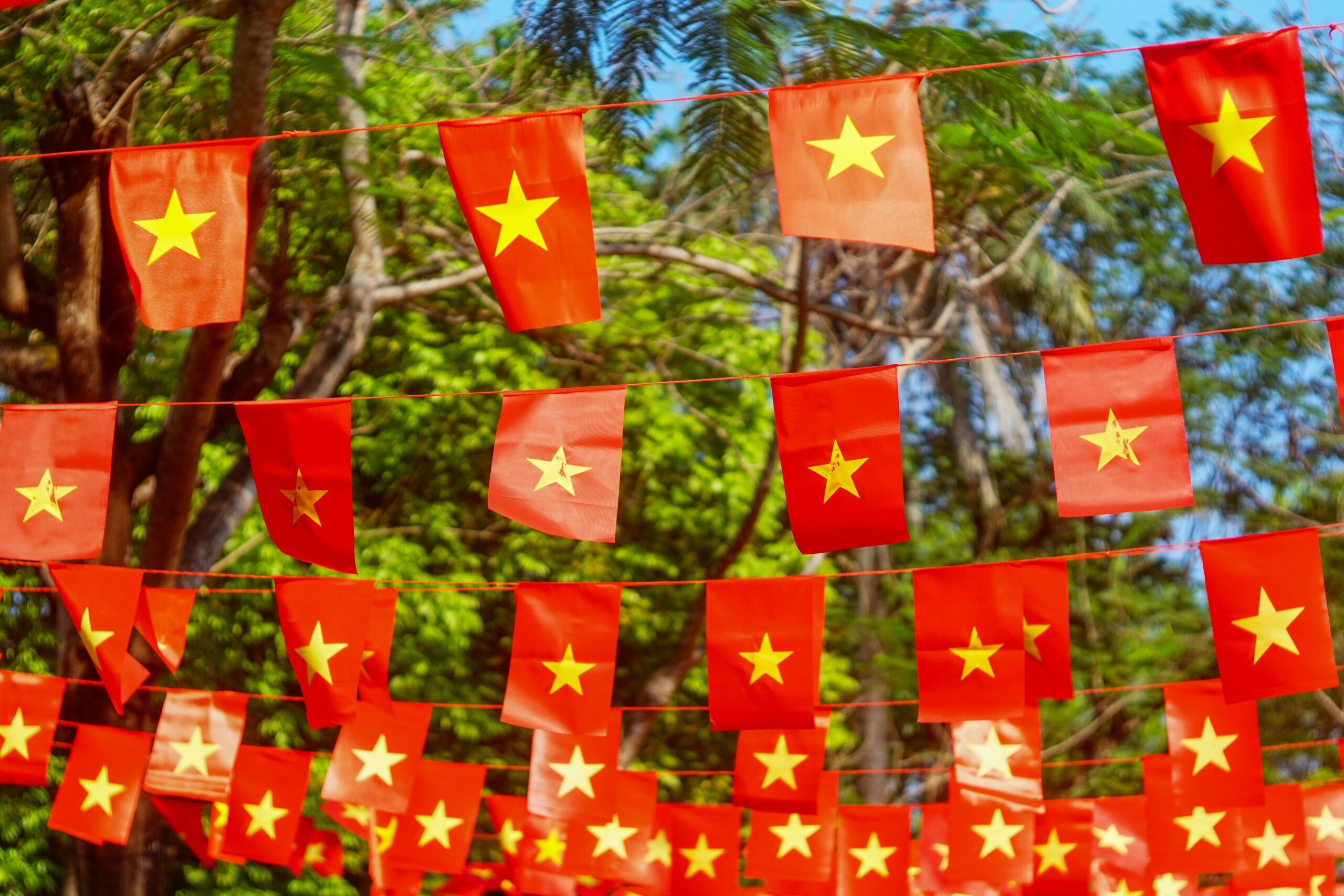
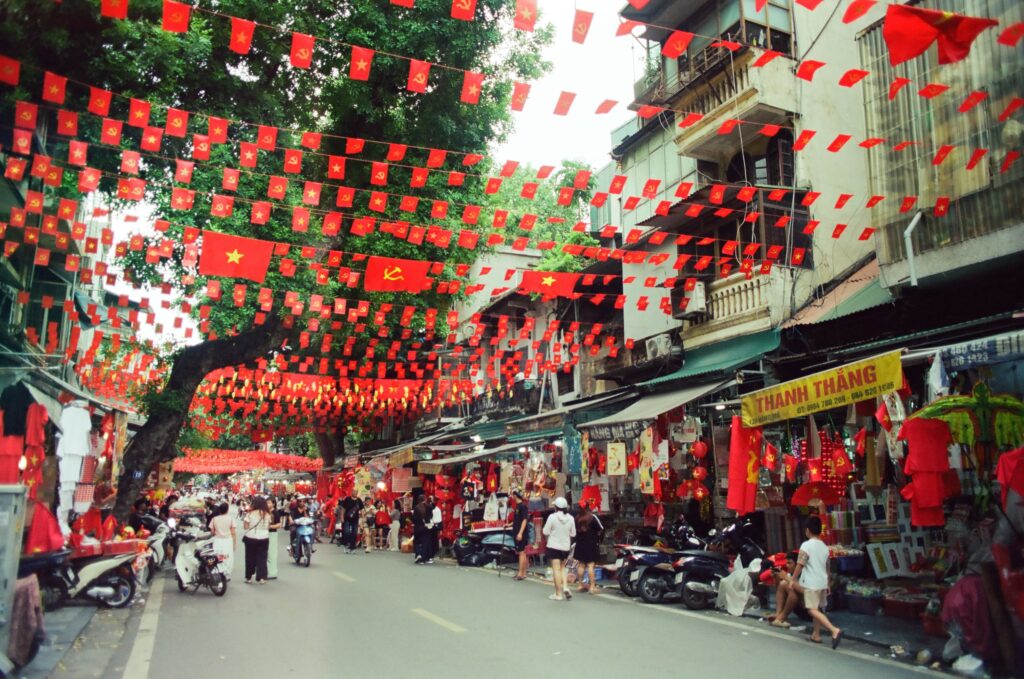
There is no need for a football tournament here. In the days before September 2, the country simply turns red. Flags hang from apartment towers, shopfronts, schools and government buildings. Entire streets become seas of red, punctuated by the yellow star. In residential neighbourhoods, a flag outside the door can feel almost as ordinary as putting up Christmas decorations in Europe. There is little of the awkwardness that a similar display of national symbols might provoke in Germany and some other Western European countries.
For a foreigner, it is easy to see all this simply as the decoration that comes with a long weekend. But the flags are worth looking at more closely. Vietnam’s National Day celebrates something that sits very near the centre of the country’s modern identity: independence. And once you understand how hard that independence was fought for, Vietnam’s relationship with its flag, its history and even today’s great powers begins to make considerably more sense.
That matters to expats, too. We live in a country that is extraordinarily open to the outside world, yet deeply protective of the idea that outsiders should never again decide its future. September 2 is a good day to understand how those two things fit together.
A Declaration With Some Familiar Words
On September 2, 1945, Hồ Chí Minh stood before a huge crowd in Ba Đình Square in Hanoi and declared the independence of the Democratic Republic of Vietnam. Today marks the 81st anniversary of that event.
The timing was extraordinary. Japan had surrendered only weeks earlier, ending the Second World War. French colonial authority had collapsed, the Japanese occupation was over, and the August Revolution had brought the Việt Minh to power.
Then Hồ Chí Minh began his declaration with words that would have sounded surprisingly familiar to an American listener: the principle that all people are created equal and possess rights including life, liberty and the pursuit of happiness.
He was deliberately invoking the American Declaration of Independence. He then referred to France’s Declaration of the Rights of Man and of the Citizen.
There is a considerable historical irony here. Vietnam was claiming its independence partly in the language of two Western great powers. France would soon attempt to restore colonial rule. The resulting war ended with the French defeat at Điện Biên Phủ in 1954. The United States would later become the principal foreign power fighting in Vietnam.
Independence had been declared in 1945. Securing it would take another generation.
From Battleground to Balancing Act
That history helps explain something about modern Vietnam that foreigners sometimes misunderstand.
Vietnam has exceptionally long memories, but remarkably flexible diplomacy.
France, its former colonial ruler, is now a Comprehensive Strategic Partner, a relationship upgraded in 2024. The United States and Vietnam normalised diplomatic relations in 1995 and became Comprehensive Strategic Partners in 2023.
Russia remains a Comprehensive Strategic Partner, reflecting ties that stretch back to the Soviet era. And then there is China, Vietnam’s enormous neighbour, ideological relative, trading partner and historical rival. Their relationship is officially a Comprehensive Strategic Cooperative Partnership and remains a stated priority of Vietnamese foreign policy.
Put those relationships next to one another and you get a pretty good picture of Vietnamese diplomacy.
Vietnam does not particularly want to choose a team.
Its official foreign policy stresses independence, self-reliance, diversification and relations with multiple partners rather than alignment with competing blocs. Its defence policy includes no military alliances, no siding with one country against another and no foreign military bases. Vietnamese officials have famously described the approach as “bamboo diplomacy”: firm roots, a strong trunk and flexible branches.
It sounds poetic. It is also extremely practical.
A country that spent much of its modern history with larger powers trying to determine its future has developed a strong preference for determining that future itself.
What National Day Means If You Live Here
That may be the most useful way for foreigners to think about September 2.
National Day is not simply Vietnam’s equivalent of a generic flag-waving public holiday. Independence is one of the organising ideas of the modern Vietnamese state. The country went through French colonialism, Japanese occupation, decades of war and confrontation with several of the world’s most powerful countries before arriving at the remarkably open, internationally connected Vietnam we live in today.
And that produces an interesting combination.
Vietnam can welcome American investment, French universities, Russian visitors, Chinese factories, Korean technology, Japanese infrastructure and millions of foreigners without seeing openness as the opposite of independence.
Arguably, the opposite is true. Modern Vietnam’s objective is to deal with everyone while belonging to no one.
So today, enjoy the quiet office, the crowded swimming pool, the fireworks, the flags and the suspiciously busy airport.
But look at those flags once more.
They are celebrating something Vietnam has spent a very long time insisting on: we decide what happens here.
Happy Independence Day, Vietnam!