



Something starts trending in California on Monday. By Tuesday, half of Vietnam appears to have seen it. By Friday, there is a local app for it.
That is only a slight exaggeration.
Ho Chi Minh City has become very good at turning global digital trends into products, and doing it quickly. AI chatbots, hyper-casual games, NFTs, photo apps, calorie trackers: if something is climbing the App Store charts, there is a decent chance somebody in Saigon is already taking notes.
The conditions are almost suspiciously good for it. Vietnam has around 85.6 million internet users and smartphone penetration of roughly 84%. TikTok alone reaches about 76 million adults. Mobile internet has become dramatically faster, with median download speeds jumping 167% in a year to 152 Mbps.
In other words, this is a country with a lot of people staring at very fast phones.
And they are not particularly shy about trying whatever turns up next.
That gives developers in Ho Chi Minh City an unusually useful home market. A new format can arrive, spread and be tested almost immediately. Then it can be repackaged for somewhere much bigger.
Gaming shows just how far that model has gone. Vietnam is now second in the world for mobile-game downloads, with 4.9 billion downloads generated by 210 active studios releasing more than 27,000 new titles a year. The surprising bit is where those players are: roughly 95% of downloads of Vietnamese mobile games come from outside Vietnam.
The domestic market, in other words, is barely the point.
Studios in Saigon are building for India, Brazil, Indonesia and everywhere else with a smartphone and an app store. And they build quickly because there is little prize for being the third studio to discover a trend with a six-month shelf life.
Then AI Arrived
AI has put this whole machine on fast-forward.
Vietnamese users spent 704 million hours in AI apps in the first half of 2026, more than twice as much as during the same period a year earlier. Those users generated 18.6 billion sessions, while spending inside AI apps nearly doubled to $14.4 million.
Some 78% of Vietnam’s online population has used an AI tool in the past three months. Among 18-to-24-year-olds, the figure rises to 86%; among students, 92%.
For a developer, that matters in two ways.
First, Vietnamese users are remarkably willing to try new digital products. That makes HCMC a relatively cheap and responsive place to find out whether an idea actually works.
Second, AI has made building the thing much easier. A small team in Bình Thạnh can now take an existing model, put a useful interface around it, add a payment system and have a credible consumer app in the store within weeks.
You no longer need to invent the technology. Sometimes you just need to notice what people want before everyone else does.
There is now more structure around the industry, too. Vietnam passed its first standalone AI law in December 2025, which took effect on 1 March 2026. Meanwhile, HCMC entered StartupBlink’s global top 100 startup ecosystems for the first time this year, reaching 98th place after climbing twelve spots.
So what does Saigon’s trend machine actually produce?
Here are five companies and products built by teams in Ho Chi Minh City that caught a global wave. Some are still riding it. One discovered what happens when the wave lands on your head.
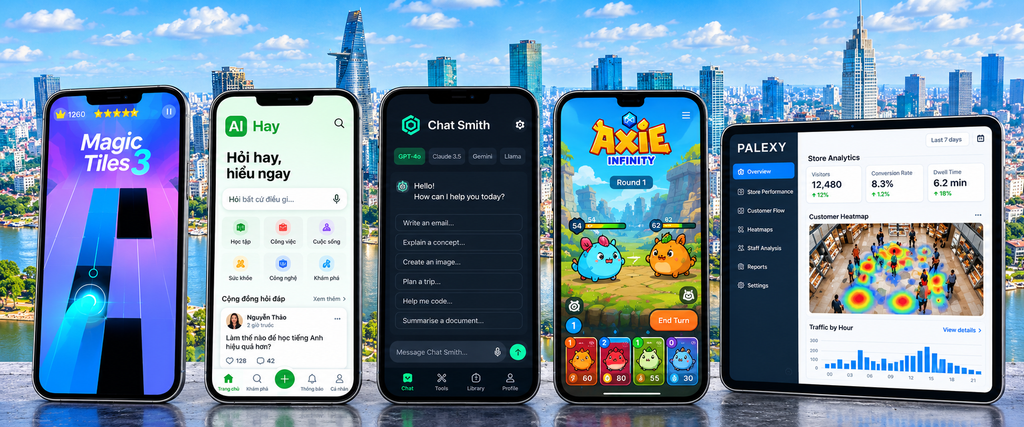
1. Magic Tiles 3 — Amanotes
Amanotes is the quiet giant of the Saigon app scene.
Its games have accumulated more than three billion downloads, and for several years it has ranked as the world’s most-downloaded music-game publisher.
Founders Bill Vo and Silver Nguyen took one of the great formulas of mobile gaming, the hyper-casual game, and added something that travels particularly well across borders: music.
Magic Tiles 3 asks you to tap falling piano tiles in time.
That is basically it.
No elaborate tutorial. No dialogue to translate. No need to know whether the player is in Hanoi, Hyderabad or São Paulo. See tile, tap tile, miss tile, swear at phone.
The company is now moving beyond pure tapping games into storytelling and progression systems while tackling the problem that hangs over much of Vietnam’s mobile-game industry: converting enormous download numbers into equally impressive revenue.
The trend it rode: hyper-casual mobile gaming, made global by making language almost irrelevant.
2. AI Hay
If ChatGPT and Perplexity had a Vietnamese cousin who spent more time on social media, it might look something like AI Hay.
Founded in 2021 by Chuong Nguyen, Duc Tran and Hiep Nguyen, the app combines large language models with Vietnamese-language content, a community of human experts and a social feed.
It has passed 22 million downloads, up from 15 million a year ago, and handles more than 100 million questions each month.
More remarkably, it is holding its own against some extremely large competitors. AI Hay ranks third for downloads in Vietnam behind ChatGPT and Gemini, and second by monthly active users.
That is a rare achievement for a local consumer AI product.
The company raised a $10 million Series A in mid-2025, taking its total funding beyond $18 million.
Its success also points to something easily missed in all the excitement about giant global AI models: local knowledge still matters. A model may be global. The questions people ask it usually aren’t.
The trend it rode: generative AI search, localised well enough to compete with the giants.
3. Chat Smith — Vulcan Labs
Vulcan Labs may be the purest example of Saigon’s app-factory model.
Founded in 2017, the HCMC company has produced more than 60 apps with over 200 million downloads across more than 100 countries.
Its flagship, Chat Smith, appeared during the great rush of third-party AI chat apps that followed ChatGPT.
And the rush paid.
In September 2023, Chat Smith reportedly generated around $1.72 million in a single month, briefly putting it within touching distance of the revenue generated by OpenAI’s own mobile app.
Look through the wider Vulcan portfolio and you can almost reconstruct recent technology trends from it: AI chat, AI voice notes, calorie counting from photographs, screen mirroring and even a Game Boy Advance emulator.
Today, Chat Smith bundles access to several frontier AI models behind a single subscription.
There is a slightly uncomfortable lesson here for anyone who believes the best technology automatically wins. Sometimes the product isn’t the underlying technology at all.
Sometimes it is packaging, distribution and knowing what people are typing into the App Store search box this week.
The trend it rode: the AI-wrapper gold rush, with distribution and App Store craft doing much of the heavy lifting.
4. Axie Infinity — Sky Mavis
And then there is Axie Infinity.
The one everyone still argues about.
Working out of Ho Chi Minh City, Sky Mavis created a game about cartoon creatures and attached an NFT economy to it. For a brief and extremely strange period, Vietnam found itself near the centre of the global crypto-gaming universe.
At its 2021 peak, players in countries including the Philippines and Venezuela were earning meaningful incomes by breeding and battling Axies. Sky Mavis was valued in the billions.
Then gravity returned.
The token economy unravelled, and in March 2022 the company’s Ronin bridge was drained of more than $600 million in one of the largest cryptocurrency hacks ever recorded.
Sky Mavis survived. Ronin still operates. But the frenzy is long gone.
Axie is the useful counterexample in this list. Catching a trend early can make a company enormously valuable.
It does not make the trend enormously sensible.
The trend it rode: play-to-earn gaming and NFTs, and a reminder that getting onto a wave early does not guarantee a pleasant landing.
5. Palexy
Palexy is not a consumer app, which is precisely what makes it interesting.
Founder Thong Do previously built AI startup Arimo in Silicon Valley and sold it to Panasonic in 2017. He later returned to Ho Chi Minh City and started looking at a rather less glamorous problem: shops.
Palexy uses computer vision to analyse footage from security cameras retailers already have. It can tell businesses where customers linger, which displays attract attention and how staff interactions affect sales.
Essentially, it tries to give a physical shop some of the analytics an online retailer gets automatically.
Clients have included Aldo and Guardian, and the company has sold into markets including Japan and Thailand as well as Vietnam.
It is a useful corrective to the idea that Saigon’s tech scene consists entirely of people racing to put a new button on ChatGPT.
The same AI tools can also be pointed at boring, expensive business problems.
Those are often where the money is.
The trend it rode: computer vision for physical retail, bringing online-style measurement into offline shops.




[…] Saigon’s Trend Machine: How HCMC Turns Global Fads Into Apps […]