


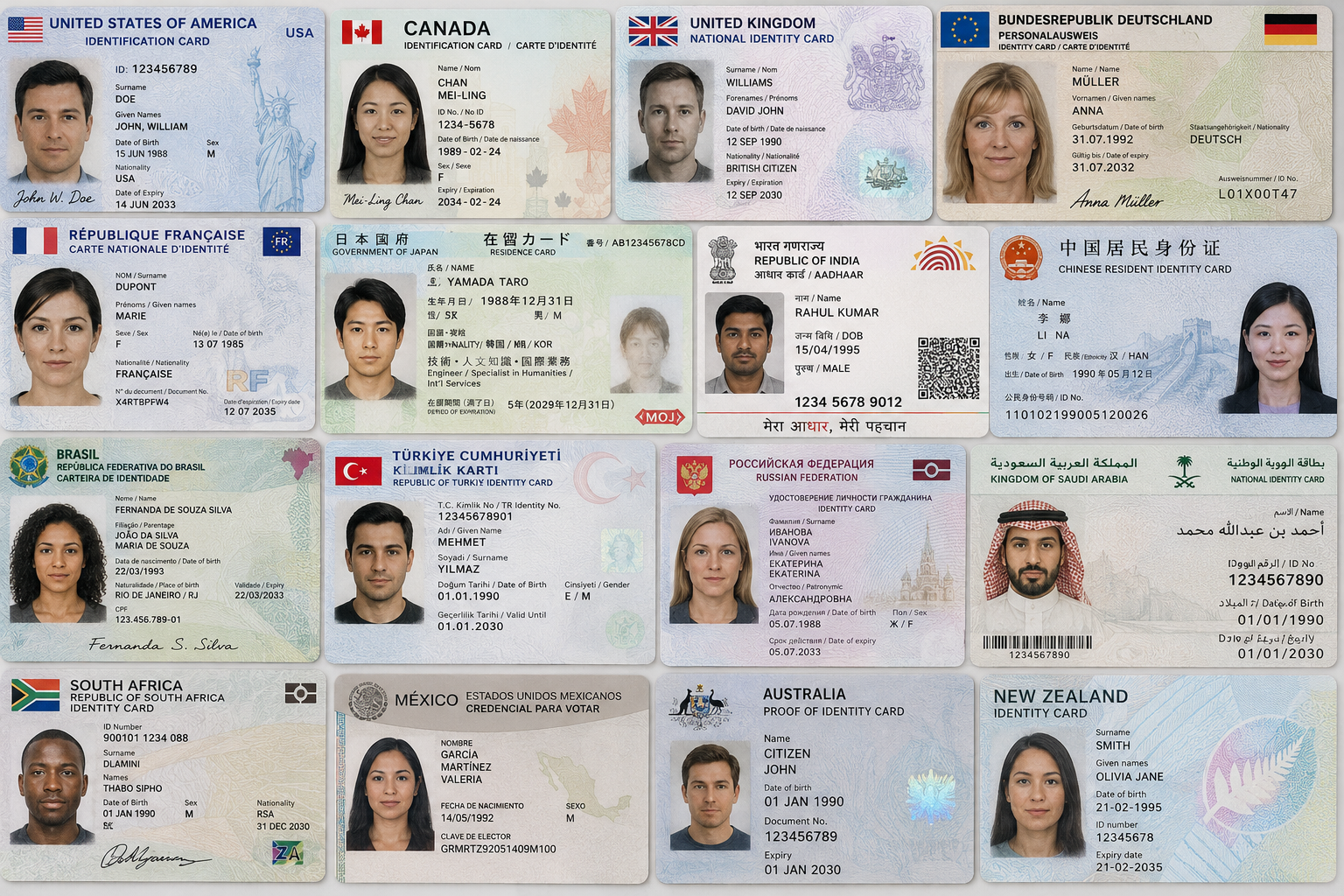
In Germany, holding an identity card is unremarkable. Everyone aged sixteen and over is required to have one, the card has carried a chip with an online identification function since 2010, and the arrangement attracts no particular comment. In Britain the same idea is treated very differently. When the government announced a national digital ID in September 2025, a parliamentary petition against it gathered close to three million signatures, one of the most-signed in British history. By January 2026 ministers had dropped the compulsory element. Ipsos polling on a national ID scheme recorded support falling from 57 per cent in July 2025 to 32 per cent in February 2026. The United States has no national identity card at all, and the closest thing to one, the REAL ID driving licence standard, took two decades to enforce.
Foreigners arrive in Vietnam carrying whichever of these assumptions they grew up with. Vietnam’s own position sits closer to the German end, and it is moving faster than either country.
What Vietnam is building
VNeID is the electronic identification application run by the Ministry of Public Security. It has been in service for Vietnamese citizens since 2021. Decree 69/2024/ND-CP opened it to foreigners from July 2024, with two account levels: Level 1, registered online, for basic lookups and transactions; Level 2, registered in person with fingerprints and a facial scan, for anything requiring real assurance. Between 1 July and 19 August 2025 the ministry ran a fifty-day campaign to issue Level 2 accounts to foreign residents holding a temporary or permanent residence card.
That framework is about to be replaced. Decree 320/2026/ND-CP, issued on 13 August 2026 and taking effect on 28 September 2026, changes three things that matter.
The level distinction disappears for foreigners. There is now one account, not two.
Eligibility widens considerably. Where an account previously required a temporary or permanent residence card, it will be available to any foreigner who legally enters or resides in Vietnam. This closes a gap that had been causing real problems for foreign legal representatives of Vietnamese companies, who often hold no residence card but are required to file through the system.
Processing gets faster and lighter. Registration remains in person at the provincial-level immigration management office of the police, with a passport, form TK01, a Vietnamese mobile number and an email address. Officers capture the facial image and fingerprints and check them against the national immigration database. An account must then be issued within two working days if the biometric data is already held, or five if it must be collected fresh, down from a previous maximum of seven. For organisations the ceiling falls from fifteen working days to ten. Separately, government agencies may no longer require documents that have already been integrated into the system.
The direction of travel is worth noting. The application can now hold 66 categories of document for individuals and 140 for organisations. The ministry is drafting a Law on Electronic Identification and Authentication that would extend identification beyond people and organisations to physical objects, intangible assets, transactions, events and locations. Every land parcel is to receive a digital identifier as the paper red book gives way to database records, with nationwide integration targeted for 2027.
The privacy question
Vietnam passed its first comprehensive data protection statute in June 2025. Law 91/2025/QH15 took effect on 1 January 2026, alongside implementing Decree 356/2025/ND-CP. It establishes the rights you would expect: to be informed, to consent or refuse, to withdraw consent, to access and correct, to request deletion. Silence is not consent. Biometric data is classified as sensitive. Penalties reach VND 3 billion for general breaches, 5 per cent of prior-year revenue for cross-border violations, and ten times the gain from unlawful trading in personal data.
The law is real, and it is stronger than what preceded it. Three points sit alongside it.
The first is structural. Enforcement of the data protection law sits with the Ministry of Public Security, which is also the ministry that operates VNeID and holds the database. There is no independent data protection authority of the kind found in the European Union. This is a deliberate design choice rather than an oversight, and it is common enough across Asia, but it means the operator and the regulator are the same institution.
The second is the size of the target. In the first half of 2025 alone, Vietnamese authorities uncovered 56 illegal data-trading operations involving more than 110 million records. That figure was part of the argument for passing the law. It is also the argument for treating any single national database as a concentration of risk. Centralisation makes a system efficient and makes a breach expensive.
The third is scope. In the UK debate, mission creep was a projected fear. In Vietnam it is published policy: the draft law openly proposes extending the identity layer to assets and transactions, with a chronological tracking mechanism whose output is intended to be admissible as legal evidence. Whether that is alarming or sensible depends on your view of the state’s role, but it should not come as a surprise later.
One practical consequence deserves flagging. Under the new decree, an account is locked automatically if the registered mobile number stops being registered in the account holder’s name according to the telecoms provider’s records. Access therefore depends on keeping a Vietnamese SIM properly registered to you, indefinitely.
What you get in return
Vietnamese administration runs on paper: notarised copies, certified translations, the same documents submitted repeatedly to different offices. The rule in Decree 320 barring agencies from demanding documents already held in the system is the substantive gain, and a larger one than it sounds.
Beyond that, the account is accepted in place of physical documents for domestic airline check-in, for identity verification and KYC at the major banks, for temporary residence registration, and for a growing range of online public services. The application has an English interface.
For anyone running a company, the calculation is different. Since 1 June 2026, organisational VNeID accounts have been required for immigration procedures including entry approval letters for foreign staff and dependants. An organisational account depends on the legal representative holding a personal one. If you are the legal representative of a Vietnamese entity, this is not a matter of preference.
It does not replace your passport for immigration control at the border.
A checklist
Work through these before deciding.
Is it already compulsory for you in practice? If you are the legal representative or director of a Vietnamese company, yes. Stop here and register.
Do you hold a temporary or permanent residence card? If so, you have been eligible since 2024. If not, you become eligible on 28 September 2026.
How long do you intend to stay? Under two years, the paperwork saved is unlikely to outweigh the office visit. Longer, and the arithmetic reverses.
Is your Vietnamese SIM registered in your own name? It must be, and it must stay that way. If your number is registered to an employer, a landlord or a friend, sort that out first or the account will lock.
Will you keep that number if you leave for an extended period? A lapsed SIM means a locked account and a return trip to an immigration office.
Do you fly domestically, bank locally, or rent under your own name? Each of these is a place where the account removes friction. None of them is impossible without it.
Are you buying or holding property? Land records are being brought into the system by 2027. Expect this to become the path of least resistance rather than one option among several.
Do you object in principle? Some people do, and the objection is coherent. The honest position is that the exemption is shrinking. Choosing not to register is currently viable and gradually becoming less so.
Can you get to a provincial immigration office in person? Registration is not remote. Budget half a day.