

Getting access to Vietnam’s growth
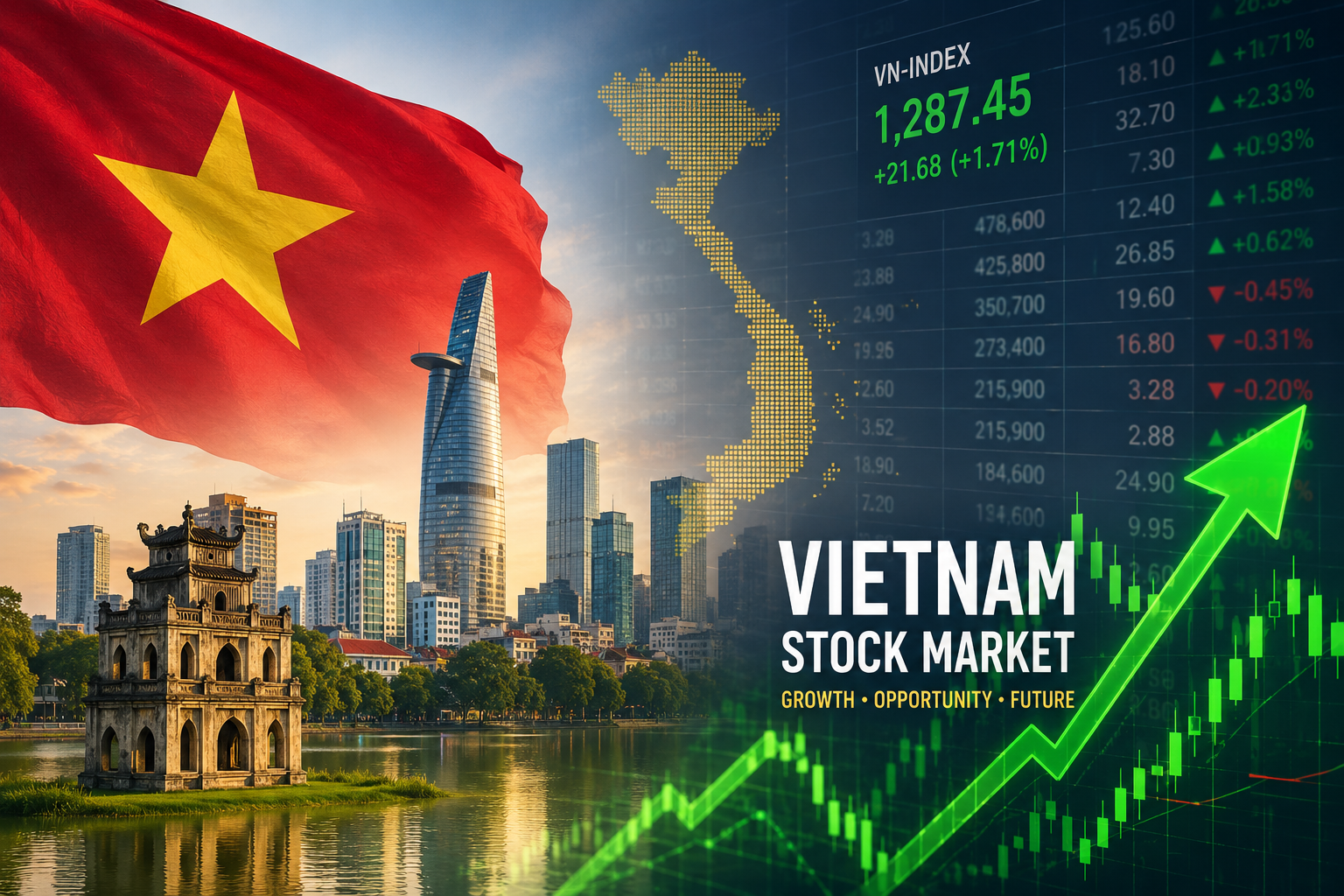
Vietnam is one of the fastest-growing economies in Asia. Growth ran above 8 per cent in the first half of 2026, manufacturing continues to draw investment away from China, and a young urban population is moving into the kind of consumption that listed companies capture. Foreign investors have wanted a position in the Vietnamese stock market for years.
Getting one directly is the problem. A foreign investor needs a securities trading code from the Vietnam Securities Depository and Clearing Corporation, which requires identity documents notarised and consularised abroad. Money must enter and leave through an indirect investment capital account held in dong at a licensed Vietnamese bank. And most companies operate under a foreign ownership limit — commonly 30 per cent for banks, 50 per cent for many other sectors. Once the limit is reached, foreign buyers cannot buy on the exchange at any price, and several of the best-known names have traded with no room for years.
That is why the FTSE Russell announcement on 21 August matters to people who will never open a Vietnamese brokerage account.
The FTSE Russell
FTSE Russell is an index provider owned by the London Stock Exchange Group. It classifies national markets by how practically foreign institutions can operate in them, and in April it confirmed Vietnam’s move from Frontier to Secondary Emerging status, effective 21 September 2026. It also builds the Global Equity Index Series, against which a large volume of money is managed passively. Those funds hold whatever the index holds. Inclusion produces buying that has nothing to do with any view of the company.
The 27 Vietnamese stocks added to the FTSE indices
On 21 August, FTSE Russell published the results of its September 2026 semi-annual review for Asia-Pacific. Twenty-seven Vietnamese stocks entered the FTSE All-Cap index, with a further 90 in the micro-cap segment. The six large and mid caps also entered the more widely tracked FTSE All-World index.
These are global size classifications. A company among the largest in Vietnam can sit in the small-cap bracket on a world scale.
Large cap
Vietcombank (VCB) — The largest listed bank by market capitalisation and the country’s principal foreign-exchange bank. Majority owned by the State Bank of Vietnam.
Vingroup (VIC) — The largest private conglomerate, founded by Pham Nhat Vuong. Property, retail, healthcare, education, and the electric vehicle maker VinFast.
Vinhomes (VHM) — Vingroup’s residential arm and the largest listed developer in the country, responsible for the Vinhomes townships including Grand Park and Ocean Park.
Mid cap
BIDV (BID) — The Bank for Investment and Development of Vietnam, among the largest by total assets, with the state holding a controlling stake.
Hoa Phat (HPG) — The largest steel producer in Vietnam, centred on the Dung Quat complex in Quang Ngai. Also in agriculture and industrial property.
VPBank (VPB) — A large private lender known for consumer finance. Japan’s Sumitomo Mitsui Banking Corporation holds a strategic stake.
Small cap
FPT (FPT) — The largest listed technology group. Software services for clients in Japan and the United States, plus domestic telecoms and a private education network.
Gelex (GEX) — Industrial and infrastructure group covering electrical equipment, water utilities and energy, with a controlling interest in the building materials producer Viglacera.
HDBank (HDB) — Retail and SME lender based in Ho Chi Minh City, with a consumer finance joint venture, HD Saison.
HSC Securities (HCM) — One of the oldest brokerages in the country, with the city’s investment fund as a major shareholder.
Masan Consumer (MCH) — Masan’s packaged food and beverage business. Chin-Su and Nam Ngu sauces, Omachi noodles, Wake-Up 247.
Masan Group (MSN) — Consumer and retail conglomerate. Owns the WinMart store network, Masan Consumer, a high-tech materials business and a long-held stake in Techcombank.
Novaland (NVL) — Property developer focused on large township and resort projects in the south. Restructuring since the bond difficulties of 2022.
SHB — Saigon-Hanoi Commercial Joint Stock Bank, a Hanoi-based private lender of mid-tier size.
Sacombank (STB) — Private retail bank with one of the larger branch networks, long engaged in resolving legacy assets from its 2015 merger.
SeABank (SSB) — Private lender associated with the BRG Group.
SSI Securities (SSI) — The largest securities company by capital, covering brokerage, asset management and investment banking.
Techcom Securities (TCX) — Techcombank’s brokerage and investment banking arm, with a large bond distribution business and among the most profitable in the sector.
Vinamilk (VNM) — The dominant dairy producer and a long-standing foreign holding. The state investment corporation SCIC remains the largest shareholder.
Vietcap Securities (VCI) — Formerly Viet Capital Securities. A brokerage and investment bank whose research is widely followed by foreign institutions.
Vietjet (VJC) — The low-cost airline founded by Nguyen Thi Phuong Thao, carrying a large share of domestic traffic and expanding internationally.
MSB — Vietnam Maritime Commercial Joint Stock Bank, a mid-sized private lender originally established to serve the shipping sector.
Vincom Retail (VRE) — The largest shopping centre operator in the country, developer of the Vincom Center and Mega Mall formats. Control was sold out of Vingroup in 2024.
Vinpearl (VPL) — Hospitality and leisure. Hotels, resorts, golf courses and the VinWonders theme parks.
VIX Securities (VIX) — A mid-sized brokerage with a substantial retail client base.
VNDirect (VND) — A brokerage known for its retail platform and one of the larger domestic client bases.
VPS Securities (VCK) — Has led retail brokerage market share on the Ho Chi Minh exchange in recent years.
Seven of the 21 small caps are securities firms and six are banks. The Vingroup family accounts for four of the 27 names.
What happens next: the September timetable
The list is provisional. A query period runs to 4 September, when the final files are published. Changes take effect after the close on 18 September, with the revised indices applying from 21 September. Inclusion will be phased in stages through September 2027 rather than applied at once, and the brokerage Vietcap estimates passive flows could reach around $1.5 billion once complete.
For an investor abroad, the practical consequence is that a global or emerging-market index fund will now hold a small quantity of these companies on their behalf, without a trading code or a capital account. The exposure is modest and it is not selective, but it is available, which for most of the past decade it was not.
Common questions
Can foreigners invest in the Vietnamese stock market? Yes, but not simply. Direct investment requires a securities trading code from the Vietnam Securities Depository and Clearing Corporation, an indirect investment capital account at a Vietnamese bank, and available room under the company’s foreign ownership limit. Indirect exposure through an emerging-market index fund is now possible following the FTSE Russell upgrade.
What does the FTSE emerging market upgrade mean for Vietnam? Vietnam moves from Frontier to Secondary Emerging status on 21 September 2026, which places its shares in indices tracked by far more institutional money than the frontier indices it is leaving.
Which Vietnamese stocks are in the FTSE All-World index? Six: Vietcombank (VCB), Vingroup (VIC), Vinhomes (VHM), BIDV (BID), Hoa Phat (HPG) and VPBank (VPB).