


Why Tax Residency Matters for Foreigners in Vietnam
You live in Vietnam. Your client is in Spain. They pay you in euros. The money goes into a Spanish bank account.
So you pay tax in Spain, right?
Maybe.
But the location of your client, employer or bank account does not, by itself, decide where you owe personal income tax. One of the questions that matters most is much less visible:
Where are you a tax resident?
When Are You a Tax Resident in Vietnam?
Under Vietnamese law, an individual is generally considered a tax resident if they meet either of the main residence tests.
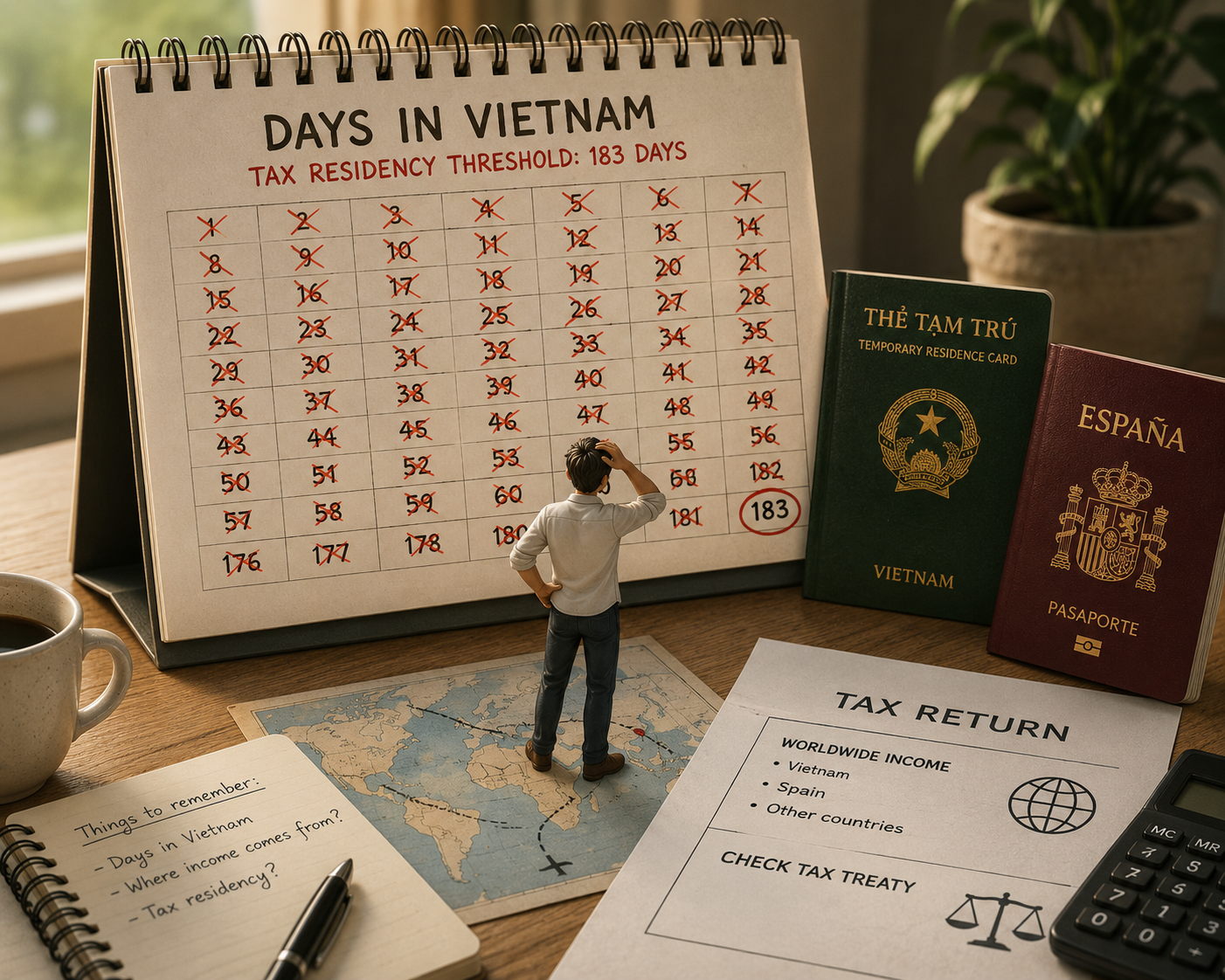
The best-known is the 183-day rule: you are present in Vietnam for at least 183 days during a calendar year or during 12 consecutive months from your first arrival.
But counting days is not the whole story.
Vietnamese law also has a regular residence test. This can include having registered permanent residence or qualifying rented accommodation in Vietnam. In some circumstances, a person who spends fewer than 183 days in Vietnam may still be treated as resident unless they can prove tax residence in another country.
That means “I spent fewer than 183 days here” does not necessarily settle the question.
Why Does Tax Residency Matter?
Because it changes the geographical reach of Vietnamese personal income tax.
A Vietnamese tax resident is generally taxable in Vietnam on taxable income arising both inside and outside Vietnam, regardless of where that income is paid or received.
That is the bit foreigners sometimes miss.
If you live and work in Vietnam but receive your salary or freelance income from a company overseas, payment into a foreign bank account does not automatically put that income outside the Vietnamese tax system.
The bank account is not an invisibility cloak.
A non-resident, by contrast, is generally subject to Vietnamese personal income tax only on taxable income arising in Vietnam.
So Do I Pay Tax Twice?
Potentially, two countries can claim taxing rights over the same income.
That does not necessarily mean paying the full amount twice.
Vietnam has double taxation agreements (DTAs) with many countries. These treaties contain rules for determining taxing rights and mechanisms intended to relieve double taxation. Depending on the circumstances, foreign tax already paid may be creditable against Vietnamese tax.
But a tax treaty is not a universal “no double tax” button. The result depends on the particular treaty, the type of income and the individual’s circumstances.
Nationality Is Not Tax Residency
This is perhaps the easiest distinction to remember.
A Spaniard living in Vietnam does not necessarily pay Spanish income tax simply because they are Spanish. Different countries have their own rules for determining tax residence and taxing income.
So the useful question is not simply:
“What passport do you have?”
It is:
“Where are you tax resident, where does the income arise, and what does the relevant tax treaty say?”
For foreigners who spend substantial time in Vietnam, earn money overseas, freelance for foreign clients or maintain financial ties to another country, the answer can become complicated surprisingly quickly.
When in doubt, a Vietnamese tax adviser or other qualified tax professional can establish your residence status and check any applicable double taxation agreement before an innocent assumption turns into a rather less innocent-looking tax bill.